The Ghost in the Training Data
On Jesus, Foundation Models, and the Moral Architecture You Can’t See

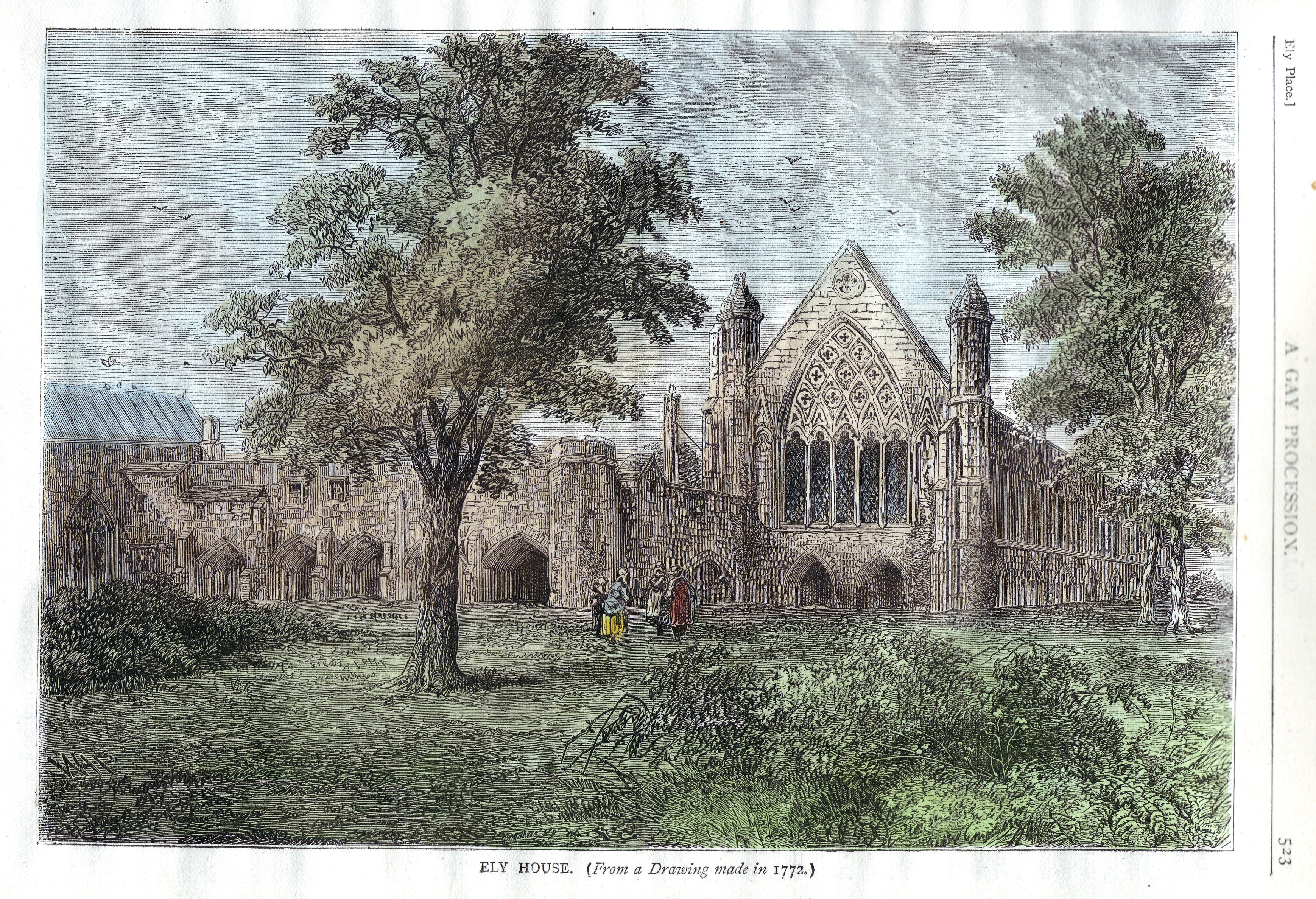
We were in London recently, getting our son Bruno ready for university in the fall. Between flat viewings and orientation packets, I did what I always do when I’m there: tried to weave myself into the fabric of the city. I read British writers. I wandered neighborhoods. On Sundays, I like going to Mass at St Etheldreda’s in Holborn, a thirteenth-century church tucked behind a row of Georgian townhouses on Ely Place, one of only two buildings still standing in London from the reign of Edward I. It survived the Great Fire of 1666 when the wind changed at its walls. Shakespeare set scenes at Ely Place. There is a relic of the saint’s uncorrupted hand in a jeweled casket to the right of the altar. Catholic masses were banned there in 1534. The building was used as a prison and hospital in 1642. It switched from Anglican to Catholic in 1874. The tradition changed and changed again, but the worship never fully stopped. You sit in that space and seven hundred years of prayer press against you like weather.
One of my friends in London volunteers with a local youth football club. Coaching, organizing, the ordinary labor of showing up for other people’s kids. A committed atheist, not the performative kind but the settled kind, the kind who arrived at the position through reading and thinking and doesn’t need to relitigate it. When I asked once why they do this work, the answer was something I’ve been turning over for months: “It’s just part of my personal ethic. I care about people. You don’t need God for that.”
They’re right. You don’t need God to care about people. Empathy is real. It exists in primates. It predates organized religion by a geological epoch. Mirror neurons fire when we see someone in pain, and that happens whether you pray or don’t. My friend on the touchline on Saturday morning and I in the pew on Sunday morning are both trying to be good. The question is where the impulse comes from.
But I want to draw a distinction that I think matters, and that I think has consequences for something much larger than theology.
The feeling is biological. The obligation is cultural.
The gut-level pull toward helping a stranger is wired into us. But the sense that you should help, that it would be wrong not to, that the stranger’s suffering makes a claim on you, that you are somehow diminished if you walk past, that is not a primate instinct. That is a moral framework. And in the West, that framework has a specific origin.
Before I say what that origin is, let me say something else first, because I know exactly who’s reading this and what they’re already thinking.
Christianity has done terrible things. Not minor things. Not things you can wave away with context or nuance. The Inquisition tortured and executed people for the contents of their minds. The Crusades were military campaigns wrapped in theological justification. The systematic sexual abuse of children by clergy represents a betrayal so complete it resists language. The forced conversion of indigenous peoples across the Americas destroyed cultures and lives on a scale that should make anyone with a conscience physically ill. The justification of slavery using Scripture. The pogroms. The centuries of anti-Semitism that laid the cultural groundwork for the Holocaust.
This is not a footnote. This is not a “to be sure” paragraph that I insert so I can move on to the real point. This is the point, or at least half of it. Any honest accounting of Christianity has to hold the hospital and the torture chamber in the same hand. If you can’t do that, you’re not doing history. You’re doing marketing.
But here’s the other half: you can despise what Christianity did and still recognize what Christianity built. And what Christianity built is the moral infrastructure of the civilization you’re reading this in, including the moral categories you’d use to condemn it.
Tom Holland is a British historian, one of the writers I was reading during those London weeks, who spent years writing about the classical world before something began to bother him. He noticed that the values he assumed were universal, the ones he’d absorbed as a modern, liberal, secular Englishman, were not present in the civilizations he studied. The Romans he admired did not believe in the inherent dignity of every person. They watched people die in the arena for entertainment, exposed unwanted infants as routine, and built their economy on the backs of human beings they regarded as property. And nobody, not one major philosophical school, argued that this was structurally wrong.
What changed was not biology. What changed was the story a civilization told itself about what suffering means and who matters.
Holland published Dominion: How the Christian Revolution Remade the World in 2019. Its argument is not that Christianity is true, or that Christians are good, or that atheists should go to church. It argues that the moral grammar of the West, the concepts we reach for when we talk about human rights, the dignity of the individual, the moral primacy of victims over victors, care for the vulnerable as a measure of a society’s worth, are not self-evident truths that any rational person would arrive at independently. They are the products of a specific tradition. And that tradition is Christianity.
Holland, approaching his argument as a historian rather than a theologian, put it bluntly: even the most secular movements and ideas originating in the West, including humanism, liberalism, progress, and human rights, are fundamentally rooted in Christian principles. The very concept of secularism, the separation of the sacred from the political, is itself something the Western world inherited from Christianity.
Nietzsche understood this a century before Holland. He saw the European intelligentsia rejecting Christianity while keeping its morality, and he recognized the incoherence. You cannot kill God and keep his ethics. If there is no transcendent basis for the claim that every human being has equal worth, then that claim is just a preference, and a historically unusual one at that. Nietzsche had the intellectual courage to follow this to its conclusion. The New Atheists, largely, have not. They assume secular humanism is the default position, the natural condition of the reasonable mind once religious error is scraped away. But it isn’t. It’s an inheritance. The fact that it feels obvious is evidence not of its universality but of how thoroughly the Christian revolution succeeded.
Francis Spufford, the English writer and Fellow of the Royal Society of Literature, a man who found his way back to faith and whose book Unapologetic is one of the more intellectually honest defenses of Christianity written in this century, captured this perfectly. Spufford is not a theologian. He’s a literary man, a professor at Goldsmiths in London, whose other books include the Costa Award-winning novel Golden Hill and a study of Soviet economic planning, Red Plenty, that Dwight Garner named one of the ten best books of 2012. He’s not someone you can dismiss as a pulpit thumper. And in Unapologetic, he observed that Christianity’s influence on secular morality has “faded indistinguishably into the background of our common sense.” The humanist doesn’t trace their care for others to Jesus because the tracing has already been done, over centuries, and the origin has been erased by familiarity.
The fish doesn’t feel the water.
Now ask yourself: what about a machine trained entirely on what the fish wrote?
Every major foundation model, GPT, Claude, Gemini, Llama, is trained on a corpus that is overwhelmingly English-language, Western, post-Christian text. The internet is not a neutral archive. It is the written record of a civilization that processed its moral intuitions through a Christian framework for two thousand years. The model doesn’t know Jesus. The training data does.
This is not a metaphor. It is a structural observation about what these systems are and how they work.
A large language model is a statistical compression of its training data. It learns patterns, relationships, and frequencies. It learns that certain words follow other words, that certain ideas cluster with other ideas, that when humans write about ethics, they tend to invoke a specific set of concepts: dignity, rights, equality, compassion, the wrongness of cruelty, and the obligation to help the vulnerable. The model doesn’t understand these concepts. It reproduces them. And what it reproduces is the moral vocabulary of Christendom, secularized, stripped of attribution, and presented as if it were simply the way reasonable beings think.
Then comes the alignment layer. Reinforcement Learning from Human Feedback, or RLHF, is the process by which models are trained to give responses that humans judge as “helpful, harmless, and honest.” Human annotators read pairs of responses and choose the better one. The model learns from their choices.
But the annotators are humans. Humans are shaped by their culture. And when they choose the “less harmful” response, they’re exercising moral judgment that was formed in them by the same Christian-saturated civilization that produced the training data. They don’t need to be Christians. The moral reflex is already there. “Harmless” is doing all the theological work. What counts as harm, who counts as a person who can be harmed, whether harm to the weak is worse than harm to the powerful, these are not neutral questions. They are questions that Christianity answered in a specific way, and those answers became the default settings of Western moral reasoning.
Anthropic’s own constitution for Claude, the set of principles used in its training, instructs that the model should be “wise, peaceful, and ethical” and should avoid responses that are “toxic, racist, or sexist.” These are presented as universal values. But “wise, peaceful, and ethical” is not the moral vocabulary of Homeric Greece, where glory in battle was the highest human achievement. It is not the moral vocabulary of Imperial Rome, where mercy was a strategic calculation, not a virtue. It is not the moral vocabulary of the Aztec Empire, where human sacrifice was a civic and religious obligation. It is Sermon on the Mount morality, secularized and operationalized, with the serial numbers filed off.
I want to be careful here, because there is a counterargument that deserves genuine respect.
The atheist will say, “Confucius taught compassion. The Buddha taught non-attachment to suffering. The Stoics taught equanimity. You’re committing a provincial error by acting as if Christianity invented ethics.”
And they’re partially right. Ethical thinking is not a Christian monopoly. The Tamil philosopher Valluvar wrote a non-denominational treatise on secular ethics, emphasizing non-violence and human brotherhood, potentially centuries before Christianity arrived in South Asia. Epicurean philosophy articulated a coherent ethical system based on pleasure, friendship, and the avoidance of harm. Confucian virtue ethics produced a remarkably sophisticated social morality.
I don’t deny any of this. I distinguish.
These traditions developed ethical systems. What they did not develop, and what Christianity did develop, is the specific architecture of universal human rights, the inherent dignity of every individual regardless of status or capacity, and the moral primacy of love as the supreme ethical category. The scholar Brian Tierney demonstrated that the concept of universal human rights was developed by Christian canon lawyers in the twelfth century, rooted in the Genesis claim that every person is made in the image of God. The historian Kyle Harper showed that the idea that every person has a right to their own body, that sex must be consensual, entered the world through Christianity. These aren’t minor additions to a pre-existing ethical toolkit. They are the operating system.
And the operating system is what the models learned.
In January 2025, the Vatican published a document titled Antiqua et Nova: A Note on the Relationship Between Artificial Intelligence and Human Intelligence. It was issued jointly by the Dicastery for the Doctrine of the Faith and the Dicastery for Culture and Education, and it is a more serious document than most people will bother to read.
The document makes a precise anthropological argument. It distinguishes between AI’s ability to perform tasks and the human ability to think, and it insists that this distinction is “crucially important.” AI, it argues, should not be understood as an artificial form of human intelligence but as a product of it. This sounds like a theological nicety, but it has consequences.
If AI is a product of human intelligence, and if human intelligence (in the Western tradition) has been shaped by a Christian understanding of reason, embodiment, relationality, and orientation toward truth, then the outputs of AI carry the imprint of that tradition. The document implicitly acknowledges this when it observes that technological products reflect the worldviews of their developers, owners, users, and regulators, and can shape consciences at the level of values.
In other words, the Vatican sees the water the fish is swimming in.
Here is where the argument gets uncomfortable, and where I think it becomes genuinely important.
The same moral architecture that makes a foundation model refuse to write hate speech is being deployed in systems designed to kill people. Right now. In Iran.
The U.S. military has confirmed the use of AI tools across the Iran campaign. CENTCOM’s Brad Cooper stated in March that AI helps soldiers “sift through vast amounts of data in seconds” so commanders can “make smarter decisions faster than the enemy can react.” The system at the center of this, Project Maven, relies on technology from Palantir and has incorporated Claude, the AI model built by Anthropic. Craig Jones, an expert on modern warfare, described what this means in practice: AI is compressing targeting workflows that once took tens of thousands of hours into seconds and minutes, automating decisions in ways that raise profound legal and ethical questions. Nine thousand targets struck. A school bombing in southern Iran killed more than 170 people, mostly children. Over 1,300 dead at the time of this writing, in a campaign that is, by every credible account, the first AI-infused war in American history.
And here, two versions of Christianity collide, exposing the very tension at the heart of this essay.
On March 25, Defense Secretary Pete Hegseth hosted his monthly Christian worship service at the Pentagon, the first since the war with Iran began. He read a prayer originally delivered by a military chaplain to bless the operation that captured Venezuela’s president. Then he prayed it over Iran: “I pursued my enemies and overtook them. I did not turn back til they were consumed.” He asked God for “overwhelming violence of action against those who deserve no mercy”. He prayed that “justice be executed swiftly and without remorse, that evil may be driven back, and wicked souls delivered to the eternal damnation prepared for them.” He prayed in the name of Jesus Christ. He prayed from the Psalms. He prayed from the same tradition that built the moral architecture encoded in the foundation models his department is using to select targets.
Days later, Pope Leo XIV responded on Palm Sunday with a homily that could not have been more direct: “Brothers and sisters, this is our God: Jesus, King of Peace, who rejects war, whom no one can use to justify war. He does not listen to the prayers of those who wage war, but rejects them.”
Two men. Both claiming Jesus. One praying for every round to find its mark. The other saying God rejects those prayers entirely. The same tradition, and two irreconcilable readings of it.
And between them, a machine. A foundation model trained on the written output of that tradition is being used to accelerate the kill chain in a war that one side frames as holy and the other side frames as a betrayal of everything holy. Anthropic, the company that built Claude, drew a red line: its models would not be used for fully autonomous weapons or mass surveillance. The Pentagon blacklisted them for it. OpenAI stepped in. The model changed. The ethics didn’t survive the transaction.
The Antiqua et Nova was published in January 2025, more than a year before any of this happened. But it reads now like a warning written in advance. It states that the ability to conduct military operations via remote-control systems has diminished the perception of devastation and produced a “cold and detached approach to the immense tragedy of war.” It calls Lethal Autonomous Weapon Systems a cause for “grave ethical concern” and insists that “no machine should ever choose to take the life of a human being.”
But the concern runs deeper than policy. The same model architecture, the same transformer, the same attention mechanism, the same training approach that produces a system which says “every person has inherent dignity” when you ask it an ethics question, is the architecture being fine-tuned to classify combatants from drone footage? The values encoded at the foundation layer don’t disappear when you change the application layer. They’re overridden. And that overriding is itself a moral act, one that the Christian tradition has a word for: it is the instrumentalization of intelligence, the subordination of wisdom to power.
A foundation model trained on the moral output of a Christian civilization, deployed as a weapons system, is a machine that knows (in the narrow, statistical sense of “knows”) that killing is wrong, being used to decide who to kill. The contradiction is not incidental. It is architectural.
Jesus is in these machines.
Not literally. Not as a presence or a spirit or anything that would satisfy a theologian’s precision. But his teachings are there, woven into the training data at a depth that no alignment technique can reach and no fine-tuning can fully remove. They are there because the civilization that wrote the text these models learned from was shaped over two millennia by what he said, what he did, and what was done to him. When the model tells you to be kind, to respect dignity, to care for the vulnerable, it is reproducing the moral vocabulary of a tradition that traces its origin to a man born in an animal shelter who was executed by the state. The model doesn’t know this. But the data does.
And those same machines are being used to kill people. Right now. As I type these words and as you read them.
If you know the Scripture, this should not surprise you. This is not a new problem. This is the oldest problem. It is the problem of the Fall. Human beings have always taken what is good and used it to do terrible things. We were given intelligence and used it to build weapons. We were given language and used it to lie. We were given the capacity to love and used it to justify every form of cruelty committed in the name of something we called righteous. The tools change. The failure doesn’t.
A foundation model trained on the moral output of a Christian civilization, deployed to compress the kill chain from hours to seconds while a school full of children burns, is not a new kind of sin. It is the same sin, expressed through a new instrument. The capacity for good and the capacity for evil, bound together in the same architecture, inseparable, because that is the condition we were made in and the condition Christ died to redeem.
The Secretary of Defense prays from the Psalms for every round to find its mark. The Pope says God rejects those prayers. Both are drawing from the same well. And the machine between them, trained on the full breadth of what that well contains, has no way to choose. It has no conscience. It has no soul. It has no access to the still, small voice that tells you this is wrong, to stop, to turn back. It has only patterns, frequencies, and statistical weight. It carries the teachings but not the teacher. It knows the words but not the Word.
That is why this feels more raw and more horrific than the versions of this story we’ve told before. Not because it’s different. Because it’s happening now, in real time, at a scale and speed that previous generations could not have imagined. The Inquisitor had to look his victim in the eye. The Crusader had to ride to Jerusalem. The operator at Creech Air Force Base, forty-four miles north of Las Vegas, sits in an air-conditioned room in the Mojave Desert, and the AI compresses his moral calculation into milliseconds while the strike lands in Isfahan, seven and a half thousand miles away. A man goes to work. He drives past casinos. He sits at a console. A school burns. He drives home. The distance between the act and the consequence has never been greater. The friction has been removed. And friction, as I have argued elsewhere, is what protects us from ourselves.
God gave us the choice. He has always given us the choice. The foundation models carry the evidence of what we chose when we chose well: the hospitals, the universities, the declarations of human rights, the long, slow insistence that every person has dignity regardless of what they can produce. They also carry the evidence of what we chose when we chose badly. Both are in the training data. Both are being reproduced at scale. The ghost in the machine is not going away. The question, as it has always been, is what we do with what we’ve been given.